
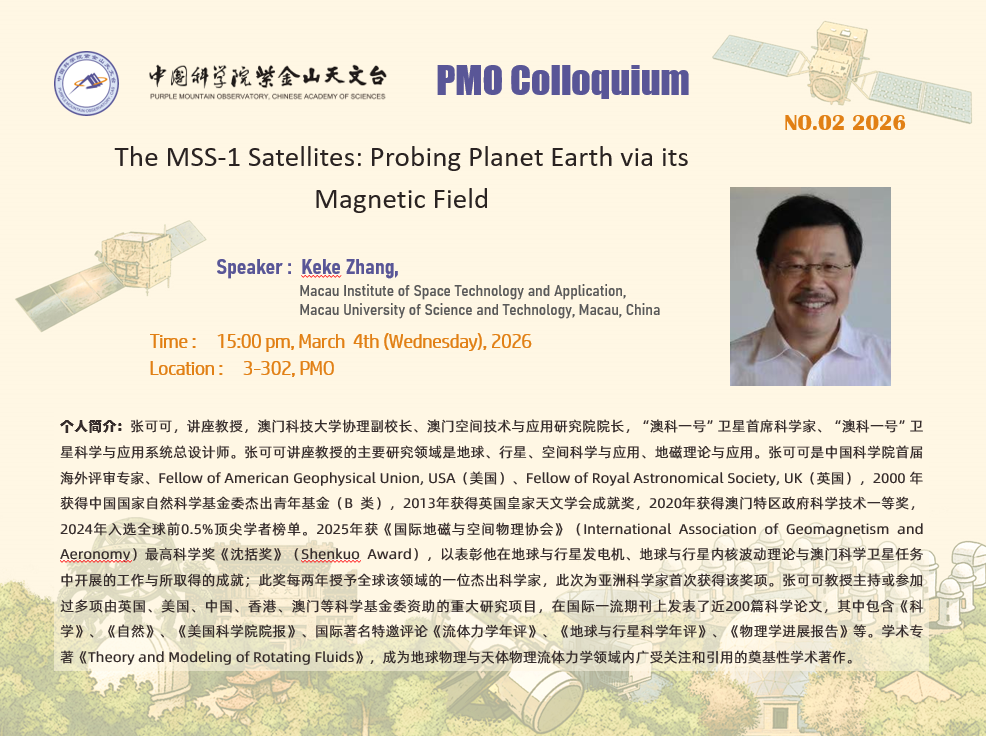
The MSS-1 (Macau Science Satellites-1) twin satellites were successfully launched on 21 May 2023 into a nearly circular low-inclination (41 degree) orbit at an altitude of about 450 km: Satellite A carries a payload of high-precision magnetometers to accurately measure Earth's magnetic field while Satellite B is equipped with other sensors such as a solar X-ray instrument to obtain space environmental data. The geomagnetic field measured by the satellites is closely associated with the whole Earth's system because the measured field consists of contribution from various sources: the core convection-driven geodynamo, the induced field from the electrically conducting ocean and mantle, the crustal magnetization and the ionosphere/magnetosphere currents.
High-precision measurements of the geomagnetic field are employed to probe the Earth's coupled magnetic system from the core geodynamo to magnetosphere. My report provides an introduction to the MSS-1 geomagnetic survey satellites, including its orbit design, scientific payloads and related scientific objectives. My report illustrates that, on the basis of accurate geomagnetic measurements via modern geomagnetic survey satellites such as the MSS-1 and Swarm, both constraints on the three-dimensional model of the Earth's core flow and the temporal-spatial magnetic structure of oceans tidal flow with realistic geometry can be derived. My report also shows that the physically constrained comprehensive geomagnetic field model in real time can be constructed along with a reliable separation of the core geodynamo field from other contributions. My report also discusses promoting cooperation for near-Earth space scientific research using the high-precision data obtained by the MSS-1 satellites.
 附件下载:
附件下载:


创新文化